Introduction to Interfaces and Message Standards
PAYMENT.ORDER (PO) application interfaces and interacts with many Temenos Transact applications and external bank host systems to fulfill its own functions and/or that of other applications. This section describes the different modes of interfaces of PO application.
PO Application Interfaces
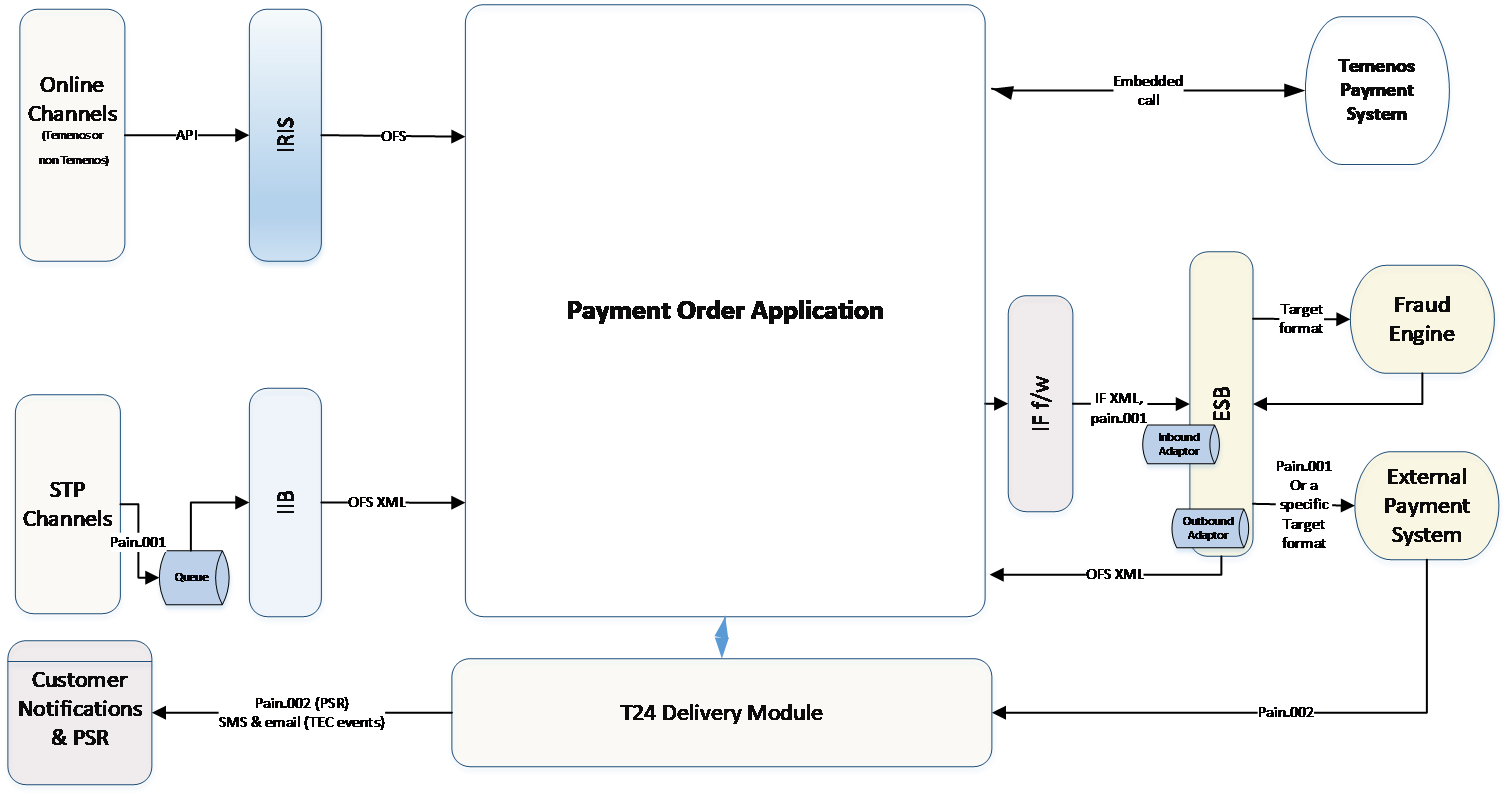
This is capable of integrating with bank channels that initiates payment requests online or offline. Additionally, it processes the payment and sends the request to Temenos Payments Hub (TPH) or other external payment system. The following illustration depicts the various interface touch points of PO application and the associated message formats.
| Interface | Description |
|---|---|
| Online Channels |
Customer-facing channels that interface with
The interface method used is APIs. |
| Offline or STP Channels | External bank channels that send payment requests in the form of pain.001 (either a single or bulk payment). |
| Interaction Framework (IRIS) | Temenos Transact framework that is used for all interactive interfaces. IRIS acts as an API gateway for external or internal applications to call-in to initiate payment requests and enquire on payment statuses using published APIs. |
| Integration Framework | Temenos Transact framework that the PO application uses to emit outgoing messages. All messages are emitted in standard Temenos Transact IF XML format. |
| IBM Integration Bus (IIB) | Temenos recommended Enterprise Service Bus (ESB) is used in association with Temenos Payment Solution to interface with all external systems. IIB also transforms the IF XML format to target formats by using XSLT transformation programs. Bank can deploy any standard ESB. |
| Temenos Payment System | PO application interfaces with TPH in interactive mode and the messages are exchanged in embedded mode (internal). In this mode, TPH processes Instant and Book Payment Orders synchronously. This means, if TPH successfully processes payment orders, they are moved to COMPLETED status in the PO application without passing through any intermediate status (for example, PLACED). Book Payments can be configured to process synchronously or as configured in TPH. |
| Temenos Transact Delivery Module | PO application interfaces with Temenos Transact Delivery module for communicating to the customer using payment status reports, alerts or notifications. |
Messaging Standards
PO application can accept payment initiation requests from electronic channels using one of the following methods:
 ISO pain.001
This is the recommended message format used (for all electronic feeder channels of the bank) to send payment request to PO application on STP mode. The messages are received in PO application using an ESB in an asynchronous mode of communication. Temenos supports IBM’s IIB as the recommended ESB solution. However, banks can use their own ESB software based on specific needs.
The supported version of the pain.001 is pain.001.001.03. PO application mandatorily supports all payment fields recommended by EPC. Additionally, a larger set of ISO recommended fields are supported for specific clearing. To know more about supported field set, refer to PO application Product Specifications. The pain.001 schema definitions vary between clients, countries, and regions. Deviations from PO application standard (pain.001) for specific Customer to Bank (C2B) requirements is taken as project specific customisations. Additionally, this is a message standard used by PO application to generate a payment order request to an external payment system (even TPH when PO application is installed with TPH as an external payment system).
ISO pain.002
PO application responds for every pain.001 order request with a pain.002. PO application also receives a pain.002 message when sent by an external payment system. The pain.002 message acts as a payment status report message. PO application updates the order status as instructed by the payment system. To know more, refer to Payment Status Report section.
APIs Exposed by PO Application (using IRIS)
This method is used to initiate payments in third-party applications (non-Temenos systems). It can be bank’s own or external systems that are connected to bank network using a suitable gateway. This is prominent in open banking, where following entities are involved:
- Payments Initiation (PI) request received from third-party providers or TPP (acting as PISP) initiating payments from the bank’s customer account.
- PI request that are captured in the bank that acts as a TPP bank (PISP) destined to another bank who holds the customer account.
APIs are hosted in Temenos Interaction Framework (IRIS) for third-party applications to call-in. API based communication is synchronous from calling programs point of view. IRIS internally uses Open Financial Service (OFS) to communicate with PO application. This interface is internal to Temenos Transact and irrelevant to calling application. PO application exposed (using IRIS) several APIs for payment initiation, enquiry, and other functionalities.
Below is the list of standard open banking APIs that can be used to interface with PO application (Berlin Group Standards).
| API Name | API Description |
|---|---|
| PAYMENT.ORDER, PX.API.INITIATE.PAYMENT.1.1.0 | Payment Initiation Request – API used to initiate payments |
| PAYMENT.ORDER, PX.API.PAYMENT.ORDER.STATUS.1.1.0 | Payment Status Response – API used to enquire the status of the order |
| PAYMENT.ORDER, PX.API.SUBMIT.PAYMENT.1.1.0 | Payment Submission Request – API used for submission of a payment |
| PAYMENT.ORDER, PX.API.CANCEL.1.0.0 | Payment Cancellation Request – API used to cancel a payment in PO application |
Following are the list of PSD2 APIs that can be used to interface with PO application:
| API Name | API Description |
|---|---|
| Payment Initiation | Payment Initiation Request to initiate payments |
| Payment Order Status | Payment Status Response to enquire the status of the order |
| Payment Submission | Payment Submission Request for submission of a payment |
Temenos OFS
This is the native interface used by Temenos Transact applications to send online payment requests to PO application. This communication mode is used in interactive mode (synchronous) where a user is waiting at the terminal. PO application reports validation errors (if any) on the captured payment request instantly and they can be displayed to user interactively for correction. Message exchange is not visible to an external operator as it is done in embedded mode between the two Temenos products.
In this topic
